 Watch 2 min video

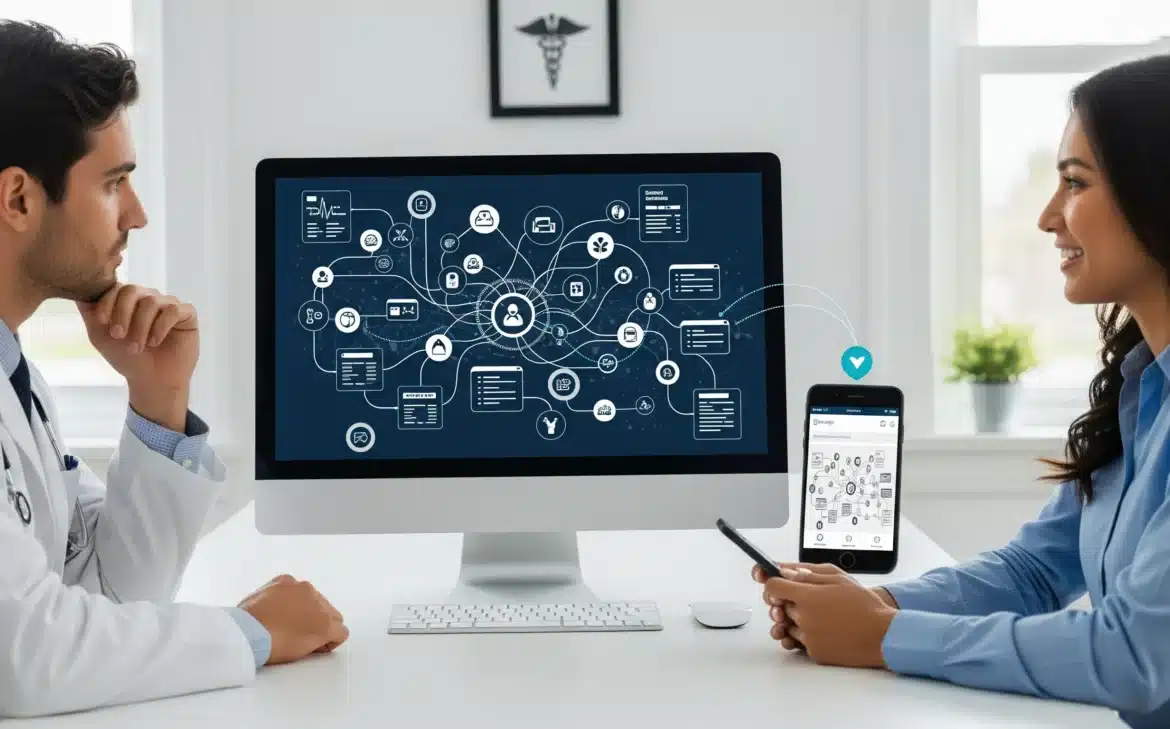
Healthcare in 2025 faces a critical reality: without semantic interoperability in healthcare, data is just noise.
Every disconnected record, mismatched code, or unreadable lab result delays care and risks outcomes. The solution? Making data universally understood, not just exchanged.
In fact, a recent PubMed study revealed that 57% of leading interoperability initiatives now prioritize semantic data harmonization across EHRs. This highlights an urgent shift. Healthcare data standardization is the foundation for efficient, safe, and scalable care.
Through HL7 FHIR standards, paired with clinical terminologies like SNOMED CT and LOINC, providers can unify fragmented records into a single and meaningful language of health.
Moreover, already, 43% of projects report faster real-time data access for clinicians, and 29% document measurable quality-of-care gains, as per the National Library of Medicine.
The momentum is undeniable: healthcare data is finally becoming smarter, not just bigger.
This guide will help you master semantic interoperability in healthcare and prepare for a future where connected systems deliver connected care.
What Is Semantic Interoperability In Healthcare?
Semantic interoperability in healthcare is the ability of systems to not only exchange data but also interpret it meaningfully. As a result, the patient information becomes usable across platforms without manual clarification or misinterpretation.
To understand this concept more clearly, let’s highlight the most important aspects:
- To begin with, it enables EHR semantic integration where data is shared and understood without context loss.
- Next, it supports clinical coding consistency through SNOMED CT implementation and LOINC terminology standards.
- Improves decision-making as systems understand the meaning, not just the structure of exchanged information.
- Lastly, it enhances FHIR semantic interoperability by unifying diverse formats into one coherent healthcare language.
Semantic interoperability in healthcare transforms fragmented datasets into actionable knowledge. Further, it improves care delivery, supporting automated regulatory compliance and building a connected, intelligent ecosystem for providers and patients alike.
The Four Levels Of Interoperability
In healthcare, interoperability functions on four levels. Each level is vital to achieving complete information exchange. While basic levels deal with sharing, higher ones emphasize meaning, integration, and impactful decision support.
Now, let’s break down the four levels of interoperability in a clear and stepwise manner:
1. Foundational Interoperability
This is the simplest level. It allows one system to send data to another. Although communication exists, interpretation is not guaranteed. For example, a scanned document shared between hospitals may still require manual reading and clarification.
2. Structural Interoperability
At this level, exchanged data follows standardized formats. Subsequently, systems interpret information consistently due to structured fields. For instance, HL7 FHIR standards help align laboratory test results, hence allowing easier mapping across different healthcare platforms.
3. Semantic Interoperability
In semantic interoperability in healthcare, systems interpret the meaning of exchanged data. It relies heavily on healthcare data standardization.
Additionally, through RxNorm medication mapping or SNOMED CT codes, data becomes universally understandable. Thus, improving diagnosis accuracy and reducing errors in treatment.
4. Organizational Interoperability
This final level extends beyond data to processes. Policies, governance, and collaboration frameworks allow seamless coordination. For instance, multi-provider networks can share unified care plans while maintaining compliance and patient trust.
In short, achieving semantic interoperability in healthcare requires progressing through these levels, where each stage builds the foundation for more meaningful and transformative data use.
Understanding the Foundation of Semantic Interoperability
Semantic interoperability in healthcare relies on structured vocabularies, consistent standards, and logical data models. As a result, systems exchange information with meaning rather than just text.
Further, clinicians gain reliable insights, improving patient outcomes and strengthening system-wide integration.
Let’s now explore the core elements that establish this foundation:
Key terminology standards (SNOMED CT, LOINC, RxNorm)
Standardized vocabularies define how data is recorded and understood.
SNOMED CT implementation supports uniform diagnosis coding, while LOINC terminology standards classify laboratory values. Similarly, RxNorm medication mapping provides clarity on prescriptions.
Together, these standards enable healthcare data standardization, advancing semantic interoperability in healthcare by reducing ambiguity and enabling consistent interpretation across systems.
The role of HL7 FHIR in semantic exchange
HL7 FHIR standards simplify interoperability by structuring data into modular resources. Moreover, they support FHIR semantic interoperability, aligning diverse systems into a unified framework. Therefore, hospitals achieve greater visibility across patient records.
In turn, EHR semantic integration becomes smoother, while healthcare data mapping accelerates clinical decision-making in real time.
Healthcare ontologies and data models
Ontologies describe relationships between medical concepts, while data models provide structure for system interpretation. Consequently, healthcare organizations can integrate legacy systems with modern frameworks.
Additionally, these models enhance clinical decision support by standardizing meaning. For smoother adoption, an EHR integration guide is often invaluable. It helps providers transition confidently to advanced interoperability solutions.
Step-by-Step Implementation Framework
Building semantic interoperability in healthcare requires a structured approach. Each stage contributes to consistency, clarity, and long-term value.
Therefore, by addressing foundational needs, aligning with standards, and optimizing workflows, organizations achieve sustainable progress.
Let’s move into the practical framework for implementation, phase by phase.
Phase 1: Assessment and planning
The first stage begins with evaluating existing systems, identifying gaps, and analyzing workflows.
At this point, healthcare leaders examine current terminology, legacy system compatibility, and integration obstacles. Furthermore, they establish strategic objectives aligned with future technology growth.
Consequently, this assessment provides a roadmap for advancing semantic interoperability in healthcare while highlighting priorities for effective execution.
Phase 2: Standards selection and mapping
During this phase, organizations decide which standards best suit clinical, administrative, and operational needs.
For example, SNOMED CT implementation, LOINC terminology standards, and RxNorm medication mapping align records with universal meaning. Moreover, healthcare data standardization strengthens communication between providers.
As a result, semantic interoperability in healthcare advances significantly and creates an effective base for broader adoption.
Phase 3: System integration and testing
After standard selection, systems must be integrated, and workflows must be tested for reliability.
Here, HL7 FHIR standards facilitate EHR semantic integration, while healthcare data mapping bridges structural gaps. Subsequently, rigorous testing uncovers issues before deployment, safeguarding clinical accuracy.
Thus, semantic interoperability in healthcare matures into a functional capability, supporting better outcomes across hospital networks.
Phase 4: Deployment and optimization
Deployment activates the system across real environments with close monitoring.
During this stage, organizations refine performance, adapt workflows, and strengthen interoperability through updates. Furthermore, long-term optimization enables adaptability as technology evolves.
Interestingly, integrating innovations like AI clinical documentation accelerates efficiency. It improves semantic interoperability in healthcare while enhancing usability across diverse medical ecosystems.
Technical Implementation Strategies
Technical implementation strategies help organizations apply semantic interoperability in structured and scalable ways. They align healthcare systems with international standards and enhance reliable data exchange.
Now let’s explore the specific methods that support semantic interoperability in healthcare.
FHIR resource mapping and configuration
FHIR resource mapping drives consistency across healthcare applications. Subsequently, it translates diverse datasets into standardized structures and reduces variability.
Moreover, semantic interoperability depends heavily on this process to support uniform communication between systems.
When mapped effectively, healthcare interoperability grows stronger, supporting clinical workflows. Additionally, resources can be configured for flexible scaling across EHR platforms.
Terminology services and concept mapping
Terminology services unify medical concepts from various databases. Through mapping, they normalize data and enable accurate interpretation across healthcare organizations.
Furthermore, semantic interoperability strengthens when terminology aligns with universal standards, hence reducing miscommunication.
As adoption progresses, providers recognize its role in harmonizing records. This alignment also supports reference models and reinforces healthcare interoperability applications worldwide.
API development for semantic data exchange
APIs are essential for structured data flow between applications. They form secure bridges and allow clinical records to travel seamlessly.
Consequently, semantic interoperability in healthcare becomes more achievable, with APIs fostering real-time access to essential information.
Additionally, healthcare interoperability benefits from modular API design, where adaptability and security stand as guiding principles. This approach supports future-ready integration.
AI and NLP for automated mapping
Artificial intelligence accelerates semantic mapping by detecting patterns and applying advanced logic. Natural Language Processing extracts context and simplifies clinical data classification.
Thus, semantic interoperability achieves greater efficiency. Moreover, healthcare systems reduce manual overhead while improving decision-making capabilities.
A robust example includes integrating AI medical coding solutions. They elevate interoperability while promoting reliable documentation accuracy across hospitals and research institutions.
Common Implementation Challenges and Solutions
Implementing healthcare interoperability can be complex because of technical, organizational, and regulatory barriers. These challenges often disrupt workflows and delay adoption.
Yet, through structured strategies, organizations can overcome obstacles while driving smoother integration and stronger patient outcomes.
Legacy system integration barriers
Many hospitals still rely on outdated software. Consequently, integrating modern solutions complicates workflows and data exchange.
Although difficult, adopting HL7 FHIR standards significantly bridges this gap. Moreover, structured approaches enable smoother connectivity and allow semantic interoperability in healthcare to support efficient cross-platform communication.
Staff training and change management
Human adoption often slows transformation. For instance, staff struggle with SNOMED CT implementation or LOINC terminology standards. Still, consistent training programs gradually ease adaptation.
Furthermore, strong leadership accelerates acceptance, while semantic interoperability in healthcare becomes a shared objective across departments. This structured alignment drives sustainable operational progress.
Data quality and standardization issues
Disorganized records weaken outcomes. Because healthcare data often lacks uniformity, interoperability suffers. Therefore, comprehensive healthcare data standardization remains essential.
Through EHR semantic integration and controlled healthcare data mapping, hospitals improve consistency. As a result, semantic interoperability in healthcare creates accurate exchanges and reduces errors while improving patient treatment reliability.
Compliance and security considerations
Balancing innovation with regulations presents difficulty. Indeed, adopting FHIR semantic interoperability raises compliance concerns. Nevertheless, hospitals leveraging RxNorm medication mapping while applying strict safeguards achieve stability.
Transparent practices support long-term trust. Consequently, semantic interoperability in healthcare strengthens security while enabling innovation across modern clinical environments.
Real-World Use Cases
Semantic interoperability in healthcare is actively transforming patient care and system efficiency worldwide. Real-world examples prove its power in hospital integration, multi-provider data sharing, and clinical decision support.
Let’s explore these scenarios to understand how the future of healthcare data mapping unfolds.
Hospital system integration examples
At Massachusetts General Hospital, semantic interoperability in healthcare enables seamless data exchange between its EHR and specialty clinics. As a result, this reduces redundancies and ensures consistent clinical documentation.
By using HL7 FHIR standards and SNOMED CT implementation, they achieve smooth EHR semantic integration across departments. This has significantly improved care coordination and patient outcomes.
Such hospital system integration is a key step toward the best AI for doctors to leverage accurate and holistic patient data.
Multi-provider data sharing scenarios
In New York, multiple providers share patient data through a Health Information Exchange platform using FHIR semantic interoperability.
This standardized approach makes healthcare data mapping across diverse EHRs efficient and reliable. Subsequently, patients benefit from a unified record accessible by primary care, specialists, and labs.
Data sharing scenarios like these reduce errors and improve treatment speed, crucial in complex care environments.
Clinical decision support applications
At Mayo Clinic, clinical decision support leverages semantic interoperability in healthcare to provide data-driven care recommendations.
According to the National Institutes of Health, its Enterprise Data Trust integrates diverse patient, research, and administrative data. This enables standardized information retrieval and decision-making with high precision.
Using RxNorm medication mapping and terminology standards, the system helps clinicians prescribe safely and avoid drug interactions.
AI-powered decision support improves diagnostic accuracy and patient safety by delivering context-specific insights. This integration exemplifies how semantic interoperability in healthcare supports advanced clinical decision systems for better patient outcomes.
Conclusion
Achieving semantic interoperability in healthcare is a critical step toward building a connected, intelligent, and patient-focused ecosystem.
With consistent healthcare data standardization, reliable SNOMED CT implementation, and adoption of HL7 FHIR standards, organizations can move past fragmented systems and unlock real value from their data.
At the same time, addressing challenges like staff readiness, data mapping inconsistencies, and compliance strengthens the foundation for effective EHR semantic integration.
This balance ensures not just smoother workflows but also improves collaboration and clinical accuracy across providers.
The journey may seem complex, but it doesn’t have to be overwhelming. At Murphi AI, we help healthcare organizations simplify interoperability, adopt proven frameworks, and achieve measurable impact.
If you’re ready to take the next step, Murphi is here to guide you. Contact us today.
FAQs
1. What is semantic interoperability and how does it differ from other types of interoperability?
Semantic interoperability in healthcare fosters consistent meaning across systems. It is unlike technical or syntactic interoperability, which only manages connections and data formats without addressing deeper context.
2. Which healthcare standards are essential for semantic interoperability implementation?
Standards like HL7 FHIR, LOINC, SNOMED CT, and RxNorm are vital for semantic interoperability in healthcare. They provide common structures, terminologies, and data consistency across healthcare systems.
3. How does FHIR enable semantic interoperability in healthcare systems?
FHIR enables semantic interoperability in healthcare through structured data exchange. Subsequently, it makes sure that clinical information remains accurate, standardized, and interpretable across multiple healthcare applications and electronic health record (EHR) platforms.
4. What role do terminology services play in semantic data exchange?
Terminology services support semantic interoperability in healthcare by enabling accurate mapping. Further, it validates code sets and ensures healthcare systems consistently interpret SNOMED CT, LOINC, and RxNorm standards.
5. How can organizations overcome legacy system barriers to semantic interoperability?
Organizations can adopt middleware, data mapping solutions, and gradual EHR semantic integration strategies to bridge legacy systems while maintaining compliance with modern healthcare data standards.
6. What are the key challenges in implementing SNOMED CT and LOINC standards?
Challenges include mapping complexity, resource training, and governance. However, addressing these barriers strengthens semantic interoperability in healthcare and improves accuracy in data standardization processes.
7. How does AI and machine learning support semantic mapping processes?
AI and machine learning enhance semantic interoperability by automating data mapping, reducing errors, and providing faster adoption of healthcare data standardization frameworks.
8. What compliance considerations must be addressed during implementation?
Healthcare organizations must align semantic interoperability efforts with HIPAA, GDPR, and automated regulatory compliance requirements to safeguard sensitive patient data and meet global standards.
9. How should organizations measure the success of semantic interoperability initiatives?
Success can be measured through improved care coordination, reduced data silos, streamlined workflows, and better clinical decision-making outcomes driven by standardized healthcare data exchange.
10. What are the long-term benefits of achieving semantic interoperability in healthcare?
Long-term benefits include enhanced patient outcomes, seamless EHR integration, improved research capabilities, and a healthcare system driven by consistent, meaningful, and shareable data.